What to Know Before Buying EnChroma Colorblind Glasses: The Critical Checklist
We have all seen the viral videos across social media. A father unwraps a box on his birthday, slips on a pair of sleek sunglasses, looks out at his backyard, and breaks down in tears because he can see the vibrant reds and greens of a sunset for the very first time in his life.
It is an undeniably powerful emotional hook. If you or a loved one are among the 8% of men or 0.5% of women living with a color vision deficiency, it is completely natural to want that exact same life-changing experience.
But before you spend over $300 on a premium pair of lenses, you need to step away from the glossy corporate marketing and look at the real clinical boundaries. The internet is full of polarizing debates: real-world users calling them a Christmas miracle, while some optometrists argue they do not perform quite how the advertisements portray them.
As a health and wellness researcher, my goal is to give you the transparent, objective truth. This definitive guide breaks down the essential factors you must know before buying EnChroma glasses to ensure you protect your wallet and fully manage your visual expectations.
Key Takeaways
Not a Genetic Cure: EnChroma glasses do not alter your retinal anatomy or cure colorblindness; they are optical assistive tools that reorganize existing light waves.
The Monochromacy Limit: The technology relies on functioning light cones and will not work for individuals with total colorblindness (monochromacy).
Lighting Constraints: Premium colorblind lenses require bright, natural sunlight to achieve full saturation and vibrancy.
Return Policy Safeguard: EnChroma offers a standard 60-day satisfaction guarantee for non-prescription models, which is critical because the mathematical variance of individual vision means results are never guaranteed.
1. Remanaging Expectations: Deficiency vs. Total Blindness
The first and most vital medical boundary to understand is that true, total “colorblindness” (achromatopsia or monochromacy) is exceptionally rare. Individuals with monochromacy lack functioning cone photoreceptors entirely, perceiving the world strictly in shades of gray, black, and white. EnChroma glasses will not help these individuals.
Instead, the vast majority of people who struggle with color are actually color deficient. This means you possess all three types of color-sensing cones (Red, Green, and Blue), but the light-absorption curves of your red and green cones abnormally overlap.
2. The Optical Mechanics: How the Lenses Actually Work
To understand why some people see an instant transformation while others experience muted results, you have to look at the physics of the lens.
When red and green light signals overlap, the eye sends a muddy, confused message to the brain. The brain cannot determine if it is looking at a dull brown, a bright red, or a deep green.
EnChroma addresses this by embedding patented Spectral Notch Filters directly into the lens. These filters dynamically target and cut out the exact, narrow wavelengths of light where the red and green signals cross paths. By filtering out this optical “static,” the lens creates distinct separation between the color channels, allowing the brain to accurately process clear reds and vibrant greens.
3. Indoor vs. Outdoor Lenses: The Lighting Rule
A common complaint found across optical forums is from users who put on their glasses indoors and feel completely underwhelmed. This comes down to lighting mechanics.
EnChroma’s core technology is optimized for bright, ambient sunlight. Outdoor lenses function by filtering intense solar rays, meaning the colors of autumn foliage, floral gardens, and traffic signals pop beautifully on a clear day.
If you want to use the technology inside for computer monitor design, watching television, or office work, you must purchase their specialized Indoor Formulation. Indoor lenses feature a distinct light-transmission profile designed to work under artificial fluorescent or LED lighting, though the visual saturation will naturally appear less dramatic than an outdoor sunset.
4. The Prescription and Return Policy Safeguard
Buying customized prescription glasses online can be a major financial gamble. Traditional local opticians do not offer a “sale or return” policy on custom prescription lenses—once the laboratory cuts the glass to your specific medical script, the sale is final.
Because color deficiency exists on a highly individualized spectrum (ranging from mild to severe Deutan or Protan variants), EnChroma cannot guarantee a 100% success rate for every single user.
To protect your investment, keep these retail safeguards in mind:
The 60-Day Guarantee: EnChroma provides a 60-day money-back satisfaction guarantee on standard, non-prescription models.
The Fitover Alternative: If you already wear prescription glasses daily, do not order a custom prescription right away. Instead, opt for their Fitover Collection, which is engineered to slip smoothly right over your existing frames. This allows you to safely test the color-filtering effects while preserving your ability to return them if your eyes do not adapt to the filtration profile.
🛑 The Mandatory Safety Step: Take the Free Digital Assessment First
Because these premium lenses are a substantial investment and depend entirely on your precise level of cone overlap, you should never purchase them blindly.
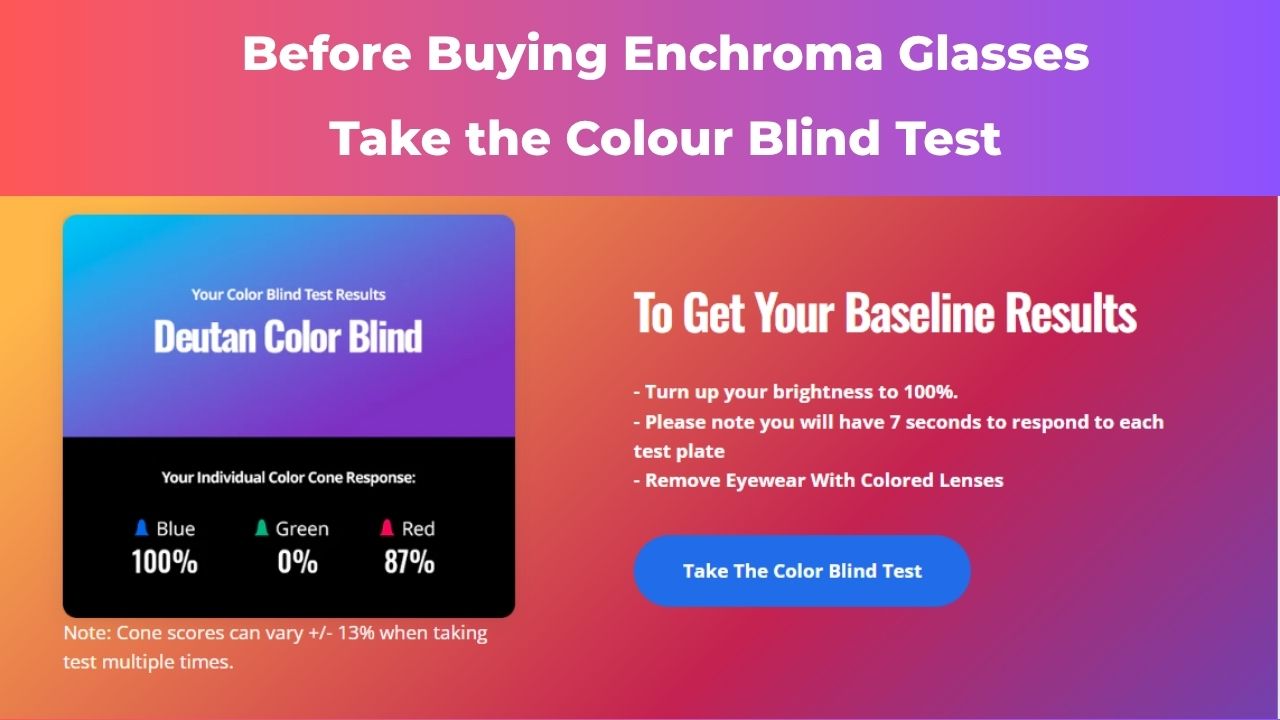
I strongly urge my readers to utilize the [Free Online EnChroma Color Blind Test] before spending a single dollar. This rapid, computer-adaptive screening mimics the clinical Ishihara dot arrays to accurately isolate whether your eyes present a Deutan (Green-weak) or Protan (Red-weak) profile, determining the exact severity level of your deficiency. It takes less than two minutes, requires zero medical literacy, and gives you the exact diagnostic baseline needed to select the correct lens format safely.
Conclusion
Are EnChroma glasses an internet scam? Absolutely not. The science behind spectral notch filtering is mathematically sound and clinically verified. But they are not a magical cure-all, and managing your personal expectations before unboxing is the key to a rewarding experience.
By determining your exact deficiency type, ensuring you have the right lighting environment, and utilizing retail safeguards like Fitover styles, you can safely explore a whole new spectrum of visual depth. Stop wondering what shades you are missing in the world around you and take the first step toward visual discovery today.
FAQ
Will EnChroma glasses fix my vision permanently?
No. EnChroma glasses are strictly passive optical assistive devices. They manipulate light as it enters your eye, but they do not alter the underlying genetic architecture of your retina or create new cone cells. The moment you take the glasses off, your color vision returns to its baseline profile.
What is the difference between Deutan and Protan conditions?
Protan refers to red-cone deficiency (red-weakness), making reds appear muted or shifted toward green and brown. Deutan refers to green-cone deficiency (green-weakness), which is the most common form of color blindness. While both profiles struggle to separate reds from greens, they require completely different optical notch placement filters, which is why identifying your type via the [Free EnChroma Screening Test] is mandatory.
Can children use these glasses for school?
Yes. EnChroma designs dedicated child-sized frames utilizing robust, impact-resistant polycarbonate lenses. However, because young children may struggle to articulate subtle visual changes, parents should use the specialized Shape Mode child test to verify their baseline vision dynamics before investing in a pair for the classroom.